
Financial affiliate marketing looks simple until you actually try to run it. Traffic comes in, dashboards light up, but money arrives later—or not at all. Publishers complain about reversals, advertisers complain about quality, and both sides quietly suspect the system is broken. It isn’t broken, but it is specific. A financial affiliate network works by different rules than ecommerce or apps, and skipping those details is how budgets disappear. This article exists to put structure where there’s usually noise. If you’re evaluating affiliate marketing in finance, this is the map you wish you had earlier.
What is a financial affiliate network?
A financial affiliate network is a platform that connects financial advertisers → with affiliate publishers → on a performance basis. Advertisers place offers in the network, publishers choose how to promote them, and the network tracks and validates every result. In finance, those results are tied to real business value: approved applications, funded accounts, issued policies, or qualified leads that pass checks.
Unlike many consumer verticals, finance requires post-conversion verification. This is why approval rates and reversals are standard, not an exception. Networks like Leadgid are built specifically around this logic, where a conversion is not considered final until it clears internal quality filters. The network sits between both sides, enforcing offer rules, standardizing reporting, and handling payouts so advertisers and publishers don’t need to manage dozens of direct contracts. In practice, a financial affiliate network is less about volume and more about controlled, accountable growth.
Who participates in a financial affiliate network
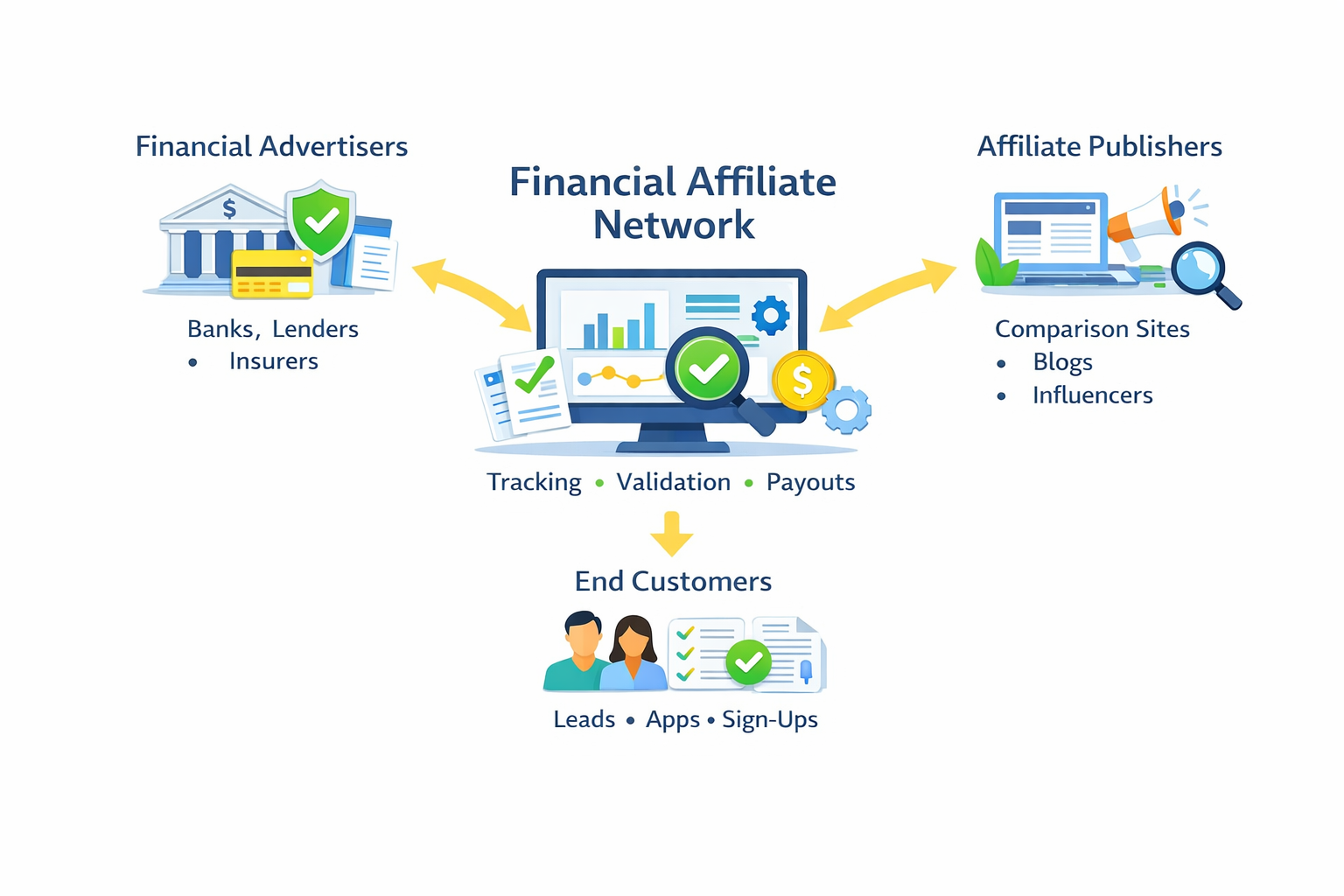
Every network revolves around a small set of roles, and understanding them removes a lot of confusion.
Core participants
-
Financial advertisers
Banks, lenders, insurers, brokerages, and fintech products looking for customers. -
Affiliate publishers
Comparison sites, content and media projects, SEO affiliates, email publishers, influencers, cashback and loyalty apps. -
The affiliate network
Provides tracking, approval logic, reporting, fraud control, and consolidated payouts. - End customers
Applicants whose actions may be validated after the click
In networks like Leadgid, these roles are clearly separated, which helps avoid blurred responsibility. Publishers know what traffic is expected. Advertisers know which actions they are paying for. Supporting roles also matter: affiliate managers help partners scale, while analysts monitor anomalies and quality issues. When those roles are missing or overloaded, finance affiliate programs tend to break down quickly.
If you're new to the industry and want to understand who actually drives finance traffic and how they monetize it, check out our guide on Who Are Financial Affiliate Publishers and How They Make Money.
Why the end customer matters more in finance
In financial affiliate marketing, the customer is evaluated after the click. Identity checks, duplication rules, funding behavior, or policy issuance all sit outside the publisher’s direct control. That’s why surface metrics can be misleading. Experienced networks, including Leadgid, focus reporting around approved value, not raw activity. Once publishers understand this, optimization decisions become much clearer and far less emotional.
How a financial affiliate network works
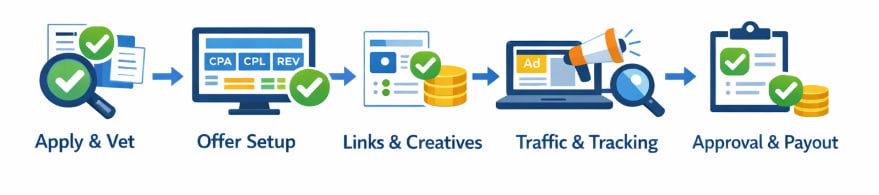
The overall flow is predictable, but finance adds extra checkpoints.
-
Advertisers and publishers apply and are vetted by the network.
-
Advertisers configure offers: payout model, allowed traffic, geos, caps, validation logic.
-
Publishers receive tracking links and approved creatives.
-
Traffic is driven via approved channels and tracked with SubIDs.
-
Conversions fire when the defined action happens.
-
Conversions are approved or reversed after checks.
-
The network pays publishers on net terms.
Networks that specialize in finance, such as Leadgid, put a lot of emphasis on steps five and six. Approval logic is documented upfront, not improvised after traffic starts flowing. This reduces disputes and gives publishers clearer feedback loops. Delays still happen, but they are expected and visible, not surprising.
Payout models and metrics that actually matter
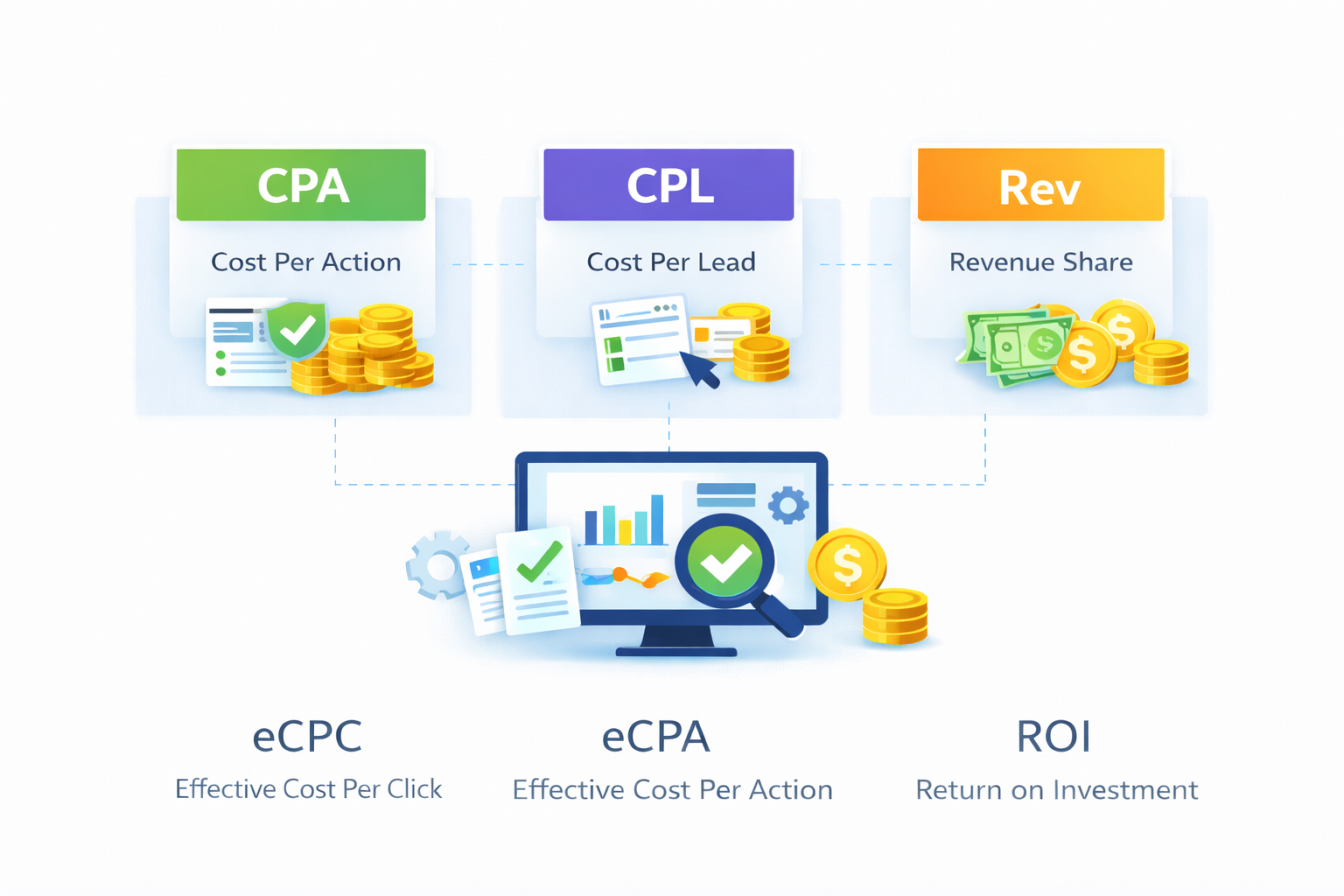
Finance payouts are tied to outcomes that carry real risk. That’s why payout models vary and are often combined.
Before the table, one key idea: the deeper the payout trigger, the lower the fraud risk—but the slower the scale.
|
Model |
What triggers payment |
Common verticals |
Key risk |
|
CPL |
Qualified lead |
Insurance, some lending |
Lead quality disputes |
|
CPA |
Approved or funded action |
Credit cards, banking, investing |
Long approval windows |
|
RevShare |
% of generated revenue |
Investing, subscriptions |
Attribution and churn |
|
Hybrid |
Mixed or staged payouts |
Fintech, loans |
Operational complexity |
Metrics that matter in practice
-
EPC after approvals
-
eCPA on approved actions
-
Conversion rate
-
Approval and reversal rates
-
Time to approval
Networks like Leadgid typically encourage publishers to optimize around approval rate early, even if it means lower initial volume. That approach tends to produce more stable revenue long term.
Traffic sources: allowed, restricted, and misunderstood
Traffic rules in finance are defined per offer, not per channel.
Commonly allowed (with approval)
-
SEO and content projects
-
Comparison pages and tools
-
Email to opted-in audiences
-
Influencer content with clear messaging
-
Native and display placements
Commonly restricted or conditional
-
Brand keyword bidding
-
Incentivized traffic
-
Co-registration and lead resale
-
Aggressive pop-ups or redirects
In practice, networks such as Leadgid encourage publishers to confirm traffic assumptions before launching. This avoids wasted spend and protects advertiser trust. When traffic rules are explicit, optimization becomes a business exercise instead of a guessing game.
Benefits for advertisers and publishers
A financial affiliate network solves different problems for each side.
For advertisers
-
Pay for verified outcomes
-
Access multiple acquisition models
-
Centralized reporting and payouts
-
Scalable partner testing
For publishers
-
Access to vetted finance offers
-
Consolidated earnings
-
Clear approval feedback
-
Account management support
Leadgid, for example, is often used by advertisers who want predictable performance and by publishers who value transparency around approvals. The shared benefit is reduced operational friction.
Affiliate networks vs in-house programs vs platforms
Not all affiliate setups serve the same purpose.
-
Affiliate networks
Marketplace, tracking, payments, and enforcement in one place. -
In-house affiliate programs
Full control, higher overhead, slower partner acquisition. -
Platforms or OPMs
Tools or managed services without deep marketplace liquidity.
Many finance brands use networks like Leadgid for scale while keeping select partners on direct deals.
How to choose a financial affiliate network
Choosing a network is a strategic decision, not a branding exercise.
Selection checklist
-
Coverage in your specific finance vertical
-
Transparency of approvals and reversals
-
Tracking and reporting depth
-
Payment terms and reliability
-
Quality of affiliate management
Networks such as Leadgid tend to appeal to teams that value clear rules and long-term partnerships over short-term spikes. Asking detailed questions upfront saves months of friction later.
[Start on Leadgid]
FAQ
- A platform that connects financial brands with publishers and pays for approved results.
- Because applications are validated after submission, not at the click.
- Yes, when messaging follows offer rules and avoids misleading claims.
- Typically Net-30 or Net-45 after approvals close.