We sat down with Yuri Kharchev — one of the people who knows LeadCore inside and out, down to the last setting. No sugarcoating: we asked him what actually hides behind the word "ecosystem," which tool affiliates tend to underrate, and where Yuri himself sees room for the product to grow. From there we broke down the tools one by one — from the offer walls to the smart link — and wrapped up with a segment on common mistakes and tips for newcomers.
BLOCK 1: LEADCORE — THE HONEST VERSION
LeadCore is called an ecosystem with no analogues out there — what does that actually mean in practice?
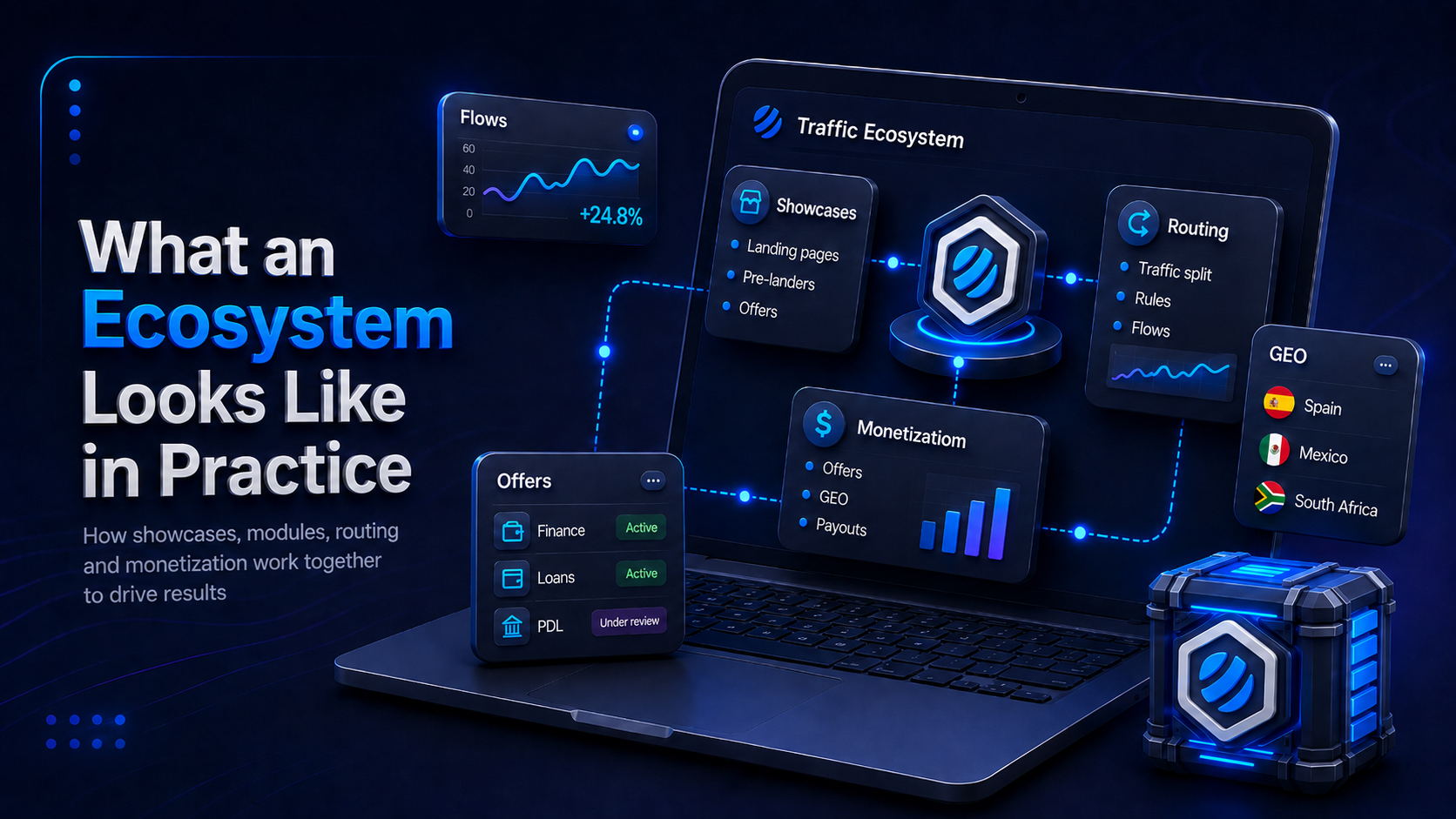
I don't want to build this answer around comparisons with competitors or say things like "nobody else has this." Sure, plenty of platforms offer website builders, offer walls, and various tools. For me, the real meaning of LeadCore as an ecosystem is something else: it's not just an offer walls builder, it's a monetization system for financial traffic.
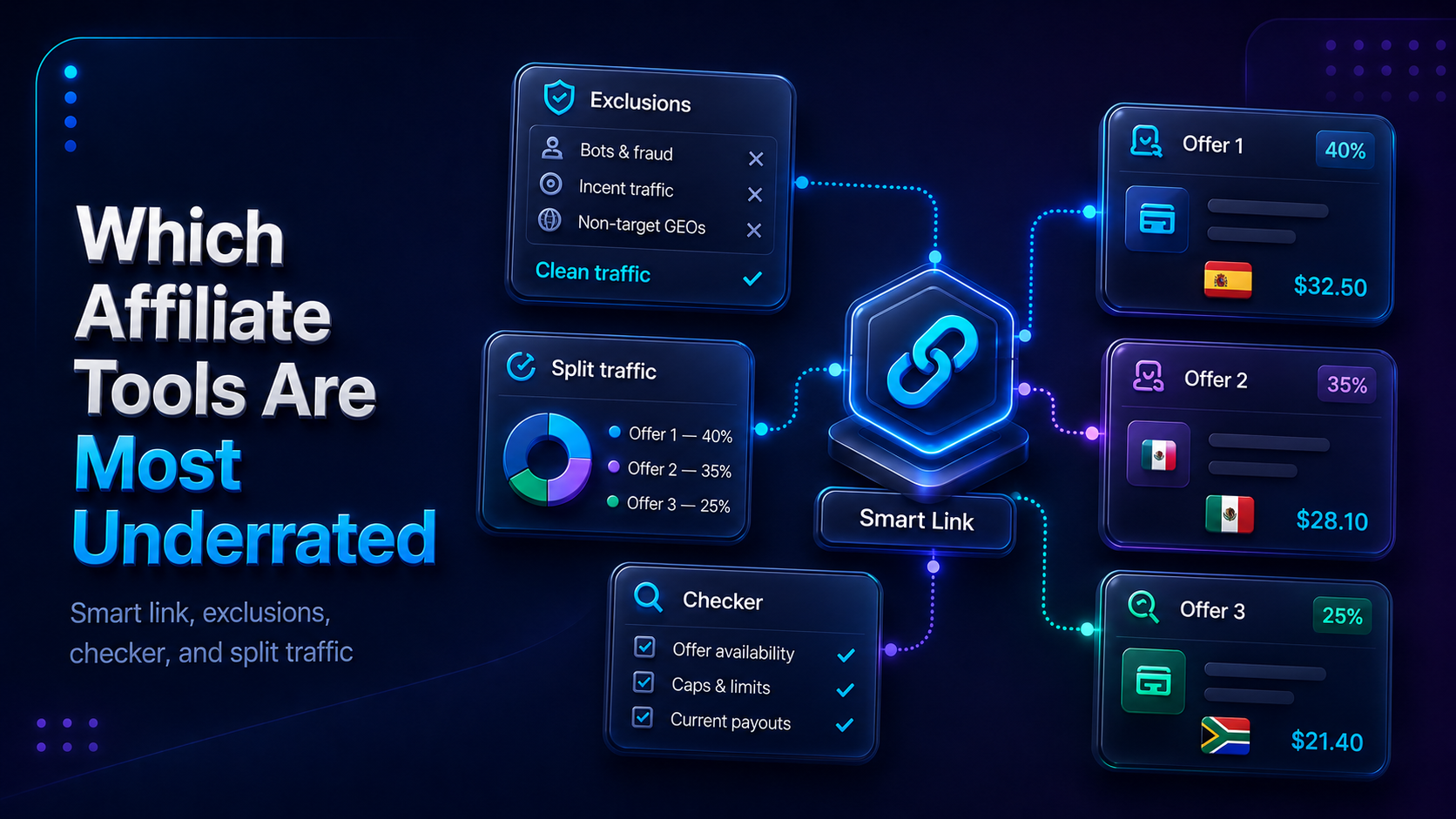
In practice, that means one dashboard brings together tools an affiliate would normally have to piece together from different services: an offer wall builder, domain parking, a built-in tracker, traffic splitting, an exclusion tool, smart links, a phone checker, API access, HTML capabilities, and offer modules. So you're not just creating a page and sending traffic to it. You can control how that traffic gets distributed, what the user sees, which offers are shown to them, which get excluded, and how different offer walls and scenarios compare against each other.
For example, you can create two offer walls, send the same traffic stream to both, and compare performance directly inside LeadCore. You can split traffic by country, city, mobile vs. desktop, device type, IP, User-Agent, browser, query parameters — work with "and/or" conditions, include and exclude different segments. This isn't just "building a site" anymore. It's closer to full-scale management of financial traffic.
The exclusion tool deserves special mention. You can avoid showing users offers they've already clicked on or converted through. You can set limits based on clicks, leads, or various other conditions. This matters a lot for the financial vertical, because repeat touchpoints with a user shouldn't be wasted — they should route the person further down a more relevant path.
There's also the smart link: an affiliate places a single link, and behind it runs a pool of offers with its own distribution logic. There's a phone checker, which helps figure out which offers are worth sending a user to and which are better excluded. And there's a comparison module for financial offers that can be embedded on your own site via code — essentially a ready-made offer block with filters by product, amount, and term.
So when we say "ecosystem," I don't mean it as a nice word for a pitch deck. It's a real set of interconnected tools that helps you launch, test, redistribute, and monetize financial traffic — all in one place.
Which tool do affiliates underrate the most — and how much profit slips by because of it?
In my view, the most underrated tool is the smart link. Especially for bots, retargeting, push notifications, Telegram, mailing lists, and any scenario involving repeat touchpoints with a user.
Why underrated? From talking with managers and partners, I've seen that there are always more questions about offer walls, domain parking, and basic setup. Questions about the smart link are noticeably fewer. And usage data within the system shows the same thing — the tool isn't used as actively as it could be.
The smart link solves a really important problem: you can place a single link anywhere — in a bot, on Telegram, in a push notification, a mailing list, a landing page, a post — and then manage the offer pool from your LeadCore dashboard. If a user has already clicked on one offer or submitted an application there, you don't have to send them back to it — you can route them to the next relevant option instead. This is especially powerful for repeat touchpoints, where the same user base can be monetized more than once.
The second underrated area is the tracker and traffic-splitting. Traffic is always a test. If an affiliate doesn't split their streams, doesn't compare offer walls, doesn't test different scenarios, they often lose money — not because the offer is bad, but because the traffic is being managed by gut feeling.
I'd be careful with exact numbers. In a solid setup, the smart link can give roughly a 15–20% boost in traffic efficiency. Smart stream distribution combined with proper tracker use can add around 20–40% in certain scenarios. That's not a guarantee or a universal promise, since it all depends on the source, the user base, the offers, and the quality of testing. But in finance, even percentages like that translate into serious money.
Is there anything about LeadCore where you'd say to yourself, "there's still room to grow here"?
Of course. In any living product, there's always room to grow. If a product is evolving, there will always be areas that can be improved.
One of those areas is templates and visual scenarios. We could expand the template library, add more variety, more design options, more randomization scenarios. But it's important not to swing too far in that direction. LeadCore shouldn't turn into a complex design tool where you spend a week tweaking every single button. Its real value lies elsewhere: launching a working offer wall quickly, plugging in monetization tools, getting data, and starting to optimize traffic.
So yes, the visual side can be developed further, but without losing focus. LeadCore is first and foremost about speed of launch and monetizing financial traffic — not an endless design sandbox.
That said, the product is already expanding in broader ways. For example, we launched the financial offer comparison module. It's a tool a partner can embed on their own site: the user sees a block of offers, filters them by product type, amount, and term, and the offers update without any complicated manual setup. Essentially, it's a format similar to financial marketplaces, but available to the partner as a ready-made module.
There's more product development ahead, but I wouldn't get ahead of myself. The main thing is not to lose the balance — giving affiliates more capabilities while keeping things simple, fast, and performance-driven.
BLOCK 2: TOOLS
Is the "5-minute offer wall" about speed of launch, or does it deliver results too?
First and foremost, it's about speed of launch. In 5 minutes you can create an offer wall, pick your top offers, set up basic logic, and start testing. But no reasonable person would guarantee results in financial traffic in 5 minutes.
Results depend on the source, traffic quality, creatives, offers, the order they're placed in, landing relevance, segmentation, and ongoing optimization. So "an offer wall in 5 minutes" isn't a promise that "you'll be earning in 5 minutes." It's about something else: you stop wasting time on technical setup and get to the data faster.
And in traffic, data is what matters most. The faster you launch, the faster you learn what works and what doesn't — which offers are delivering EPC, where CR is dropping, which offer wall is worth scaling, and which one to shut down.
Two affiliates, one offer, one GEO — one has a 3% CR, the other 8%. Where does the difference come from?
CR can't be evaluated in isolation from EPC, revenue, volume, and traffic quality. One person might have an 8% CR on a small, well-filtered volume, while the other has a 3% CR on broader traffic — but that doesn't always mean the second one is performing worse. You need to look at the whole picture.
That said, if we're talking specifically about the CR gap, it's usually lost not in the offer itself, but across the whole chain: traffic source, creative, the promise made in the ad, the landing page, the offer wall, offer order, exclusions, load speed, mobile optimization.
CR isn't some magic property of the offer — it's the sum of small decisions made across the entire chain.
The first common cause is misleading or irrelevant ads and landing pages. An affiliate might promise one thing in the ad and show the user something different on the offer wall. For example, the ad mentions a gift, a promo, or special terms, but none of that appears on the landing page. The click might be cheap, but the person arrives with the wrong expectations, and conversion drops. Another affiliate is more direct and honest: the click costs more, but the user understands exactly where they've landed, and CR is higher.
The second cause is the lack of an exclusion tool and proper logic for repeat touchpoints. One affiliate excludes an offer once a user has already clicked on it or submitted an application. Another keeps showing the same offer to everyone, racking up more clicks but not more conversions.
A simple example: one gets 100 clicks and 8 leads, another gets 300 clicks and 9 leads. The second one has a lower CR, but the problem may not be the offer — it may be that they're casting a wider net without filtering out repeat touchpoints.
On top of that, offer order on the offer wall, the quality of the offer wall itself, headlines, banners, load speed, and mobile version all play a role. In finance, there's no single magic setting. The result comes from a whole series of small decisions.
How "smart" is the smart link really, and when do you still need to keep an eye on it?
The smart link is "smart" not in the sense of "press a button and it does everything for you." I'd put it this way: it's a smart distributor, but the quality of its work depends on how well the affiliate has put together the offer pool and set up the logic.
The idea itself is simple: the affiliate places a single link pointing to a group of offers. On click, LeadCore selects a suitable offer from the pool, taking into account position within the group, GEO, conversions, activity, and offer availability. The smart link can replace a standard link shortener and works especially well for mailing lists, bots, pushes, Telegram, and traffic-back scenarios.
There's automatic logic built in: offer ranking (including by EPC), exclusion of offers based on conversions, based on conversions and clicks, and a click-based exclusion threshold. If an offer gets disabled, it automatically drops out of the smart link — no need to remove it manually, it simply stops being served.
But you still need to monitor the smart link. Not whether an offer is on or off, but the pool logic and the results: which offers are getting traffic, which are being excluded, where EPC is dropping, where there are clicks but no conversions, which offer order works better.
If you just throw in a random set of offers and forget about it, that's not proper use of the tool. But if you track EPC, clicks, conversions, and exclusions, the smart link genuinely helps you extract extra monetization from repeat touchpoints.
The phone checker and +40% approval rate — walk us through how this works on real traffic?
I'd be careful with a phrase like "+40% approval," because any specific number depends on the user base, offers, source, and scenario. In certain setups the increase can be quite substantial, sometimes even above 20–40%, but I wouldn't sell the checker as a magic button. It's more accurate to say the checker can deliver a noticeable boost in approval rate through more precise user routing.
Here's how it works on real traffic: the checker isn't meant for just "running the whole database through it." Its proper use is as a pre-check before sending a user to an offer.
For example, an affiliate has a mailing list, a bot, or some other scenario for working with a user base. Before showing a person a specific offer, the phone number gets checked via API. The system determines which offers this user has already submitted applications for or converted on. After that, the affiliate doesn't send them back to something they've already seen — instead, they route them to offers where the odds of getting a new application or approval are higher.
As a rough example: say there are 20 offers in the affiliate program, and the checker is available for 15 of them. We check the number and see that the user already had activity on 6 of those offers. So it makes sense to exclude those 6 and send traffic to the remaining options. This immediately makes working with the database smarter — you're not burning the contact by repeating the same offer.
But it's important to use the tool correctly. Sending the entire database through the pre-check in bulk is the wrong approach. That can overload advertisers' checkers and signal that the affiliate doesn't fully understand how the tool works. The right logic is to check the number at the moment of touchpoint: before a mailing, before a redirect, before showing an offer in a bot or on a offer wall.
The ideal combo is the checker, the exclusion tool, and the smart link together. The checker helps figure out which offers are best excluded in advance. The exclusion tool prevents already-used offers from being shown again. The smart link helps manage the offer pool and route the user further along a more relevant path.
The boost in approval rate doesn't come out of nowhere. It comes from the traffic becoming cleaner and more relevant.
BLOCK 3: MISTAKES AND QUICKFIRE
What's the most common mistake in setting up LeadCore — the one that keeps coming back?
The most common mistake is treating LeadCore as just an offer wall rather than as a traffic management system.
Many people launch an offer wall and stop right there. But that's exactly where the real work begins: splitting streams, smart links, exclusions, offer ranking, EPC analysis, testing different templates and scenarios.
The offer wall is just the first layer. After launch, you need to look at which offers are performing, which should be moved higher, which should be removed, where EPC is dropping, how mobile vs. desktop traffic behaves, and what's happening across different devices and GEOs. You can test different offer wall designs, banners, custom blocks, widgets, traffic-back/comebacker features, and offer order.
The mistake is running traffic through one offer wall a single time, changing nothing, and concluding "it doesn't work." That's not a real test. Even with a small budget, it's better to split it into several parts and test a few hypotheses. Not randomly — with a plan: what you're testing, which metric you're watching, and what decision you'll make once you see the first data.
LeadCore provides the tools for optimization, but they actually need to be used.
An affiliate tried LeadCore, didn't get results, and left — what most likely went wrong?
Often the affiliate leaves not because LeadCore didn't work, but because they stopped before reaching the point where real optimization begins.
There are two big competencies in financial traffic. The first is the traffic source: you need to understand who you're bringing in, with what intent, from which creative, device, GEO, and platform. The second is monetization: how you present offers, how you build the offer wall, how you use exclusions, smart links, widgets, traffic-back, and how you analyze EPC.
If an affiliate built a simple offer wall, ran traffic through it, got no conversions, and left — they tested only the most basic scenario, not the whole of LeadCore.
They needed to dig deeper: change the offer order, turn on exclusions, try the smart link, split-test different offer walls, separate mobile and desktop traffic, look at Android and iOS separately, check GEO and platforms. Maybe for their traffic, a classic offer wall wasn't the right fit — maybe a smart link, a quiz, a bot, or a different logic would have worked better.
On top of that, there are additional monetization tools: widgets, redirects, traffic-back. Each one can add a little — 1%, 3%, 5%. And sometimes a change in logic can multiply revenue several times over. But it's all case-by-case, and you can't see it without analysis.
There's also work with the user base, but that involves legal consent and proper handling of personal data. I won't go too deep into that topic here, but it's worth understanding: the more complex the scenario, the more responsibility comes with setting it up.
If you could keep only one LeadCore tool — which would you choose, and why?
Speaking from a product perspective, for most affiliates, I'd choose the offer wall. In the financial vertical, the offer wall is most often the foundation for basic traffic monetization. It's the clearest entry point into LeadCore: build an offer wall, pick your offers, connect a domain, launch a test, and then optimize from there.
But speaking personally, as someone who works more with traffic sources, landing pages, quizzes, bots, and performance scenarios, I'd choose the smart link.
For me, the smart link is more flexible. I can drop it into a single-page landing, a quiz, a chatbot, or any other scenario built on my end. And behind it, LeadCore's own logic for offer distribution, exclusions, clicks, and conversions keeps working.
That's not a contradiction. The storefront is the universal foundation for financial traffic. The smart link is a more flexible tool for people who know how to build their own landings and scenarios but want to plug LeadCore's performance logic into them.
A newcomer has just opened LeadCore for the first time. Where should they start so they don't waste the first couple of days?
I wouldn't start by randomly clicking around the dashboard — I'd start with a short onboarding process.
First — reach out to a manager and ask them to walk you through the product quickly: what's located where, which tools you need to get started, and what's better left alone until you understand it. This saves a lot of time.
Second — check out the training materials. Inside the tools there are videos and materials on building storefronts, using the dashboard, and the main features. There are also articles and documentation covering LeadCore: offer walls, traffic splitting, API integration, the checker, the smart link, modules, exclusions, and other tools. I'd spend time on this before launching, not after already burning through your first budget.
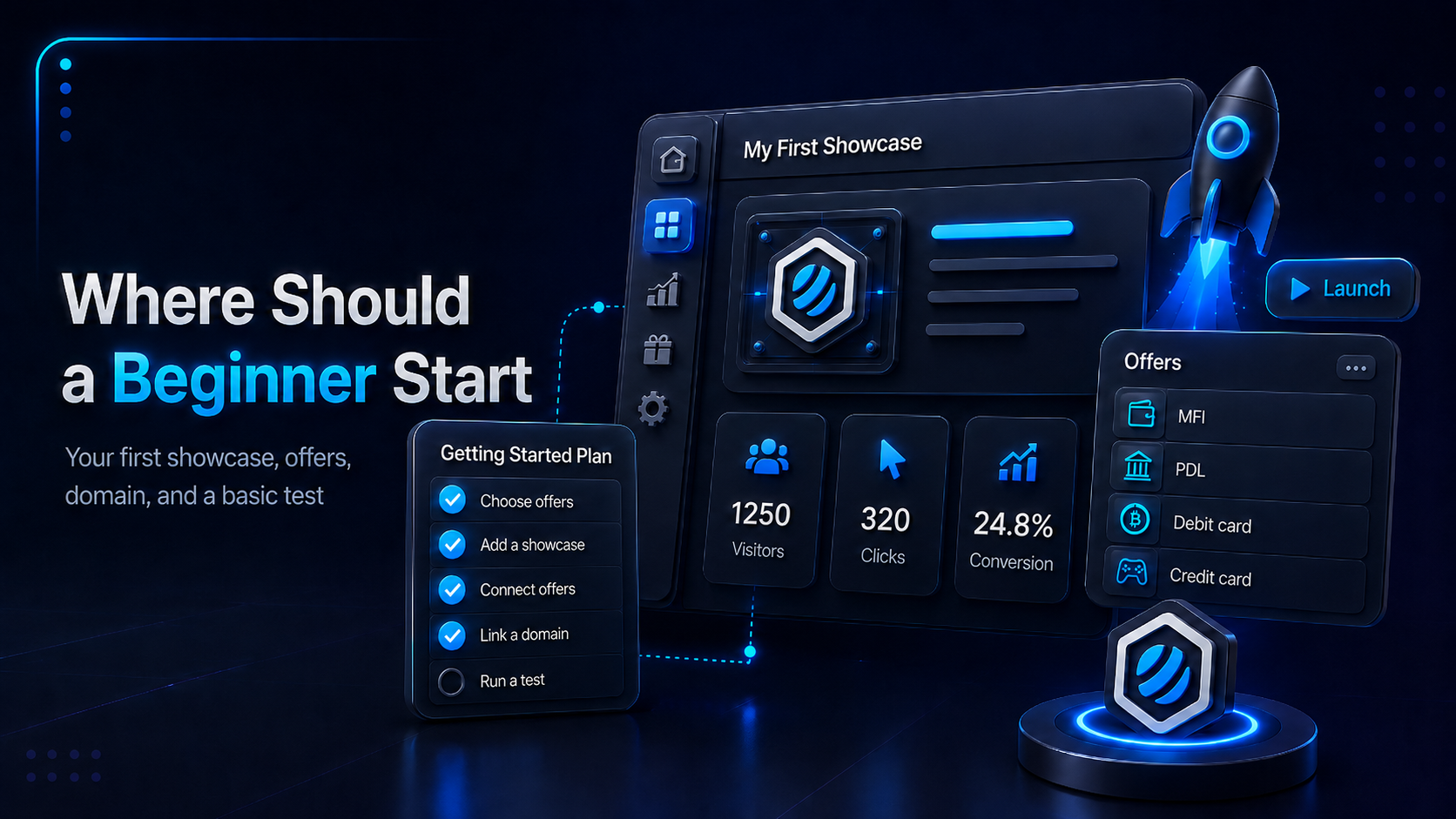
Third — build your first simple offer wall. Don't try to build the perfect, complex system right away — go through the basic steps: pick offers, put together an offer wall, park a domain, and check that everything loads properly, that clicks go through correctly, and what the mobile version looks like.
Fourth — put together a test plan in advance. Not just "launch it and see," but understand exactly what you're testing: offer wall template, offer order, traffic source, mobile vs. desktop, smart link, exclusions, traffic-back. Even with a small budget, it's better to test a few variables than to spend it all on one scenario and learn nothing.
And fifth — look at other people's examples and case studies on financial monetization. This is easy to do quickly nowadays: read articles, ask a manager, break down examples with AI, see how others build their storefronts and funnels. But it's important not to copy blindly — adapt it to your own traffic source and your own skill set.
LeadCore doesn't look like a tool that takes months to figure out. But it's easy to lose the first couple of days if you don't grasp the core logic: it's not just a storefront builder — it's a system for managing and monetizing financial traffic.
Conclusion
That's the honest conversation we had — no polish, no fancy promises, just the mechanics that actually work. If you want to try this out on your own traffic — sign up with the Leadgid affiliate network and see what works for you.